
Indoor Navigation for Events: GPS, BLE, QR Compared

Indoor navigation for events helps attendees find booths, sessions, entrances, and other locations when GPS is not reliable inside a convention center. Common options include QR-code wayfinding, Bluetooth Low Energy (BLE) beacons, and Wi-Fi or UWB positioning, each offering a different level of accuracy, setup, and infrastructure.
For many trade shows and conferences, QR-code wayfinding combined with an interactive floor plan provides a simple way to give attendees directions without additional hardware or an app download. Events that require continuous indoor positioning can also consider BLE, Wi-Fi, or UWB systems.
Why GPS Alone Doesn’t Work Indoors
GPS works best outdoors, where a device has a clear connection to satellite signals. Inside convention centers, large roofs, concrete walls, multiple floors, and other structural elements can significantly reduce GPS accuracy.
That makes indoor event navigation different from standard outdoor navigation. Instead of relying entirely on GPS, organizers can use technologies such as QR codes connected to a digital floor plan, BLE beacons, or Wi-Fi and UWB positioning.
The right option depends on the venue, event size, required level of accuracy, budget, and how much infrastructure the organizer wants to manage.
The Three Indoor Navigation Options Compared
The main difference between these technologies is how they determine an attendee’s location.
QR-code wayfinding gives attendees a known starting point when they scan a QR code and can then provide directions through the event floor plan. BLE beacons can estimate a device’s position using signals from hardware installed around the venue. Wi-Fi and UWB positioning can provide more advanced indoor location capabilities but generally require additional infrastructure and technical setup.
For event organizers, greater positioning precision usually means more hardware, configuration, and venue coordination. The most advanced technology is not always necessary if attendees simply need an easy way to find a booth or session.
QR-Code Wayfinding: The Default for Most Events
QR-code wayfinding is a practical option for trade shows, conferences, and exhibitions because it can work without dedicated positioning hardware or an attendee app.
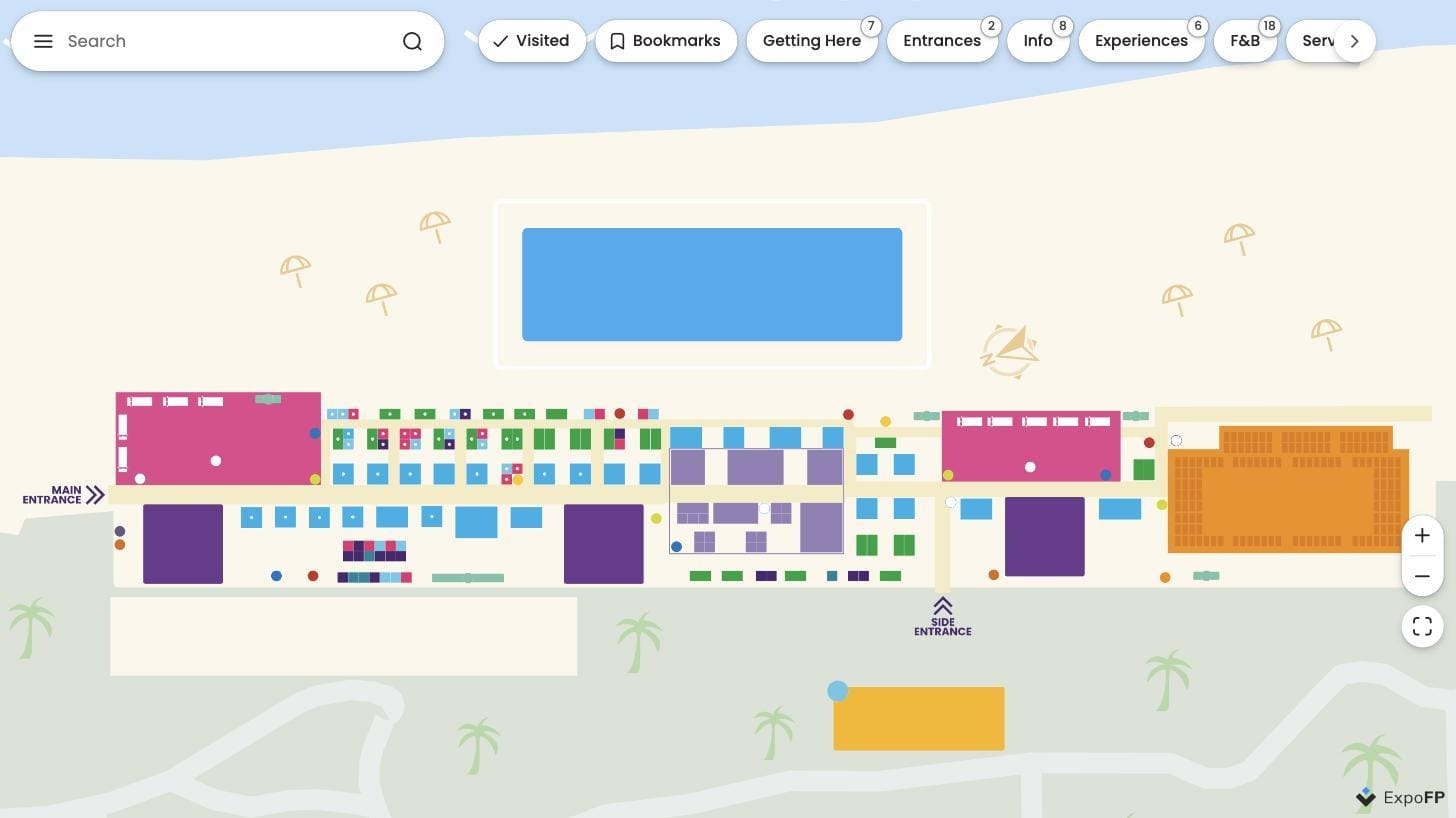
QR codes can be placed at entrances, information desks, kiosks, printed directories, or other known locations around the venue. When an attendee scans a code, the interactive event map opens with that location as the starting point, allowing them to search for a destination and get directions.
Unlike real-time indoor positioning, QR-code wayfinding does not continuously track an attendee as they move. Instead, each scan establishes a known starting location. This keeps the setup simple while still giving attendees clear directions through the event.
It can also work well for events that combine indoor and outdoor spaces, where organizers want to provide one consistent navigation experience across the entire event footprint.
BLE Beacons: Real-Time Tracking for Large Single Venues
BLE beacons are small wireless devices installed throughout a venue. A compatible mobile app can detect signals from nearby beacons and use them to estimate the attendee’s position on a digital map.
This approach can be useful for large venues or events where real-time indoor navigation is important. However, it also introduces additional setup. Beacons need to be installed, configured, tested, and maintained, and attendees will generally need a compatible app to use the positioning functionality.
For temporary events, organizers should consider whether continuous location tracking provides enough additional value to justify the hardware and setup required.
Wi-Fi and UWB: Highest Precision, Highest Investment
Wi-Fi positioning uses signals from wireless access points to estimate a device’s location, while Ultra-Wideband (UWB) can provide more precise indoor positioning through dedicated infrastructure.
These technologies are often better suited to permanent facilities or venues that can use the same infrastructure across multiple events. Convention centers, campuses, airports, and other large facilities may already have some of the required systems in place.
For a temporary trade show, however, the additional infrastructure and venue coordination may make these options more complex than necessary.
What Large Trade Shows Actually Use
For trade shows and conferences, indoor navigation doesn’t always require dedicated positioning hardware. Combining QR codes with an interactive floor plan and built-in wayfinding gives attendees a simple way to find exhibitors, sessions, and other locations from their phones.
Organizers can place QR codes at entrances, information desks, kiosks, and other points around the venue. After scanning, attendees can use that location as their starting point, search for a destination, and get step-by-step directions through the interactive floor plan.
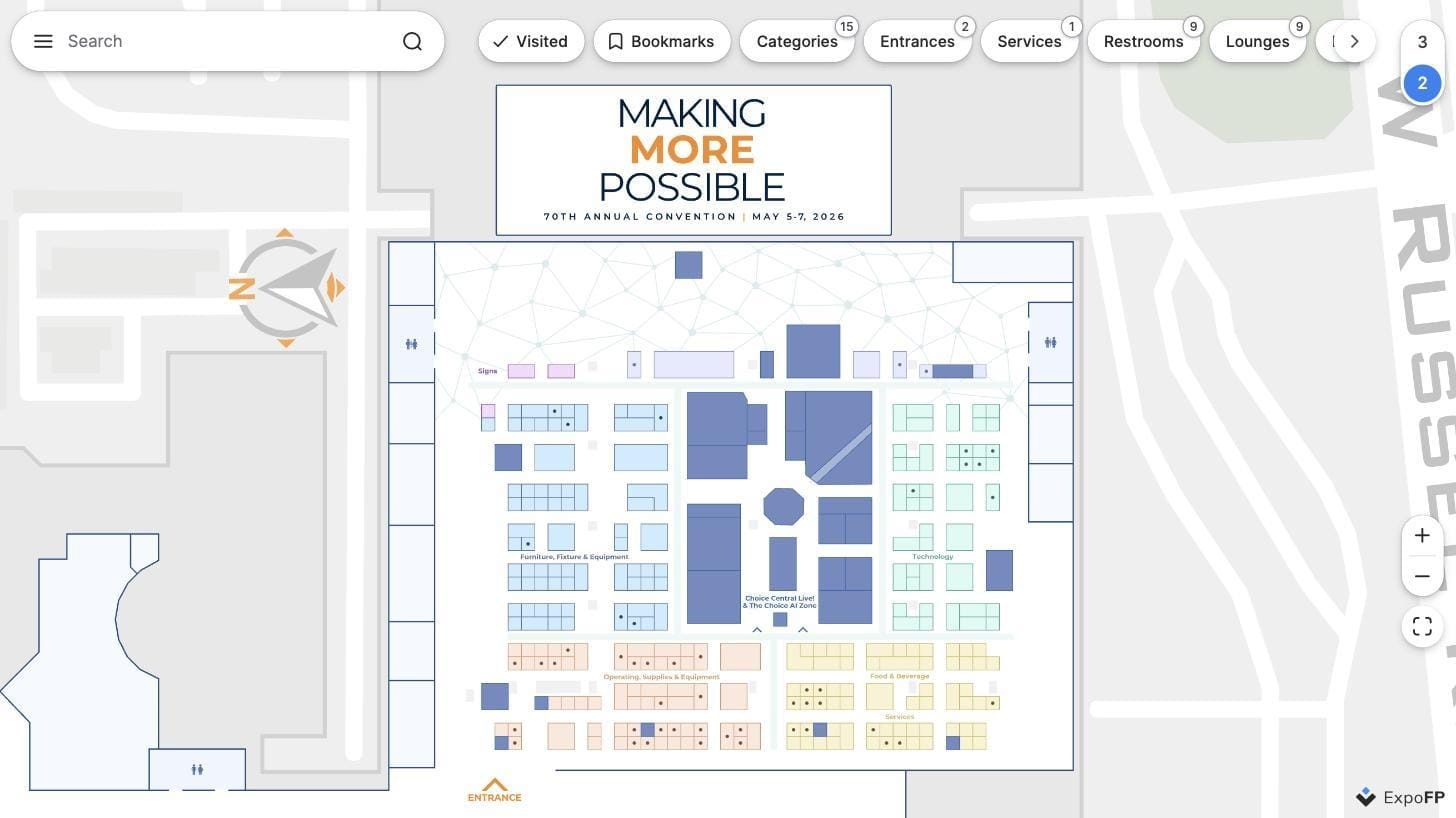
This approach works particularly well for temporary events because it doesn’t require beacon hardware and can support multiple starting points across the show floor. Events such as IMEX Frankfurt and the Choice Hotels Annual Convention show how digital event maps can support navigation across large exhibition spaces.
For organizers, wayfinding becomes part of the same interactive floor plan attendees already use to search for exhibitors and explore the event, rather than requiring a separate indoor navigation system.
For venues that host events year-round, BLE or UWB infrastructure may make sense because it can be reused across multiple shows. For temporary or annual events, QR-code wayfinding on an interactive floor plan offers a simpler approach, with less hardware, setup, and maintenance required.
Choosing the Right Indoor Navigation Option
The best indoor navigation system depends on the event size, venue, setup time, and whether attendees need continuous location tracking or simply an easy way to find their destination.
- Short-term trade show or conference: An interactive floor plan with QR-code wayfinding provides a simple way to search for exhibitors and get directions without installing dedicated positioning hardware.
- Large or multi-hall event: QR codes can be placed at multiple locations across the venue, giving attendees convenient starting points for wayfinding between booths, halls, and other event areas. BLE can also be considered when continuous real-time positioning is required.
- Permanent venue: Wi-Fi, BLE, or UWB may be a good fit when the infrastructure can remain in place and support events throughout the year.
- Mixed indoor and outdoor event: A mobile-friendly interactive map with QR-code entry points can provide one consistent navigation experience across different event areas.
- Short setup timeline: QR-code wayfinding requires less physical infrastructure and can be added directly to the digital event map, making it easier to prepare navigation as the floor plan is finalized.
For many temporary events, the advantage of QR-code wayfinding is that navigation can be part of the same interactive floor plan attendees already use to search for exhibitors, explore the venue, and find booths.
FAQ
Does GPS work inside a convention center?
GPS accuracy can decrease significantly inside large buildings because roofs, walls, and other structures interfere with satellite signals. This is why events often use dedicated indoor navigation methods.
What is a simple indoor navigation option for a trade show?
QR-code wayfinding connected to an interactive floor plan is one option that does not require dedicated beacon hardware. Attendees scan a QR code to establish their starting location and then use the map to find booths, sessions, or other destinations.
Do attendees need an app for BLE beacon navigation?
BLE positioning generally works through a compatible mobile application that can detect beacon signals and calculate the attendee’s approximate location.
What is the difference between BLE and QR-code wayfinding?
BLE can provide continuous estimates of an attendee’s location, while QR-code wayfinding establishes a known starting point each time a code is scanned. The best approach depends on whether the event requires continuous tracking or simply point-to-point directions.
Is UWB suitable for trade shows?
It can be, particularly when a venue already has the necessary infrastructure. For temporary events, organizers should compare the additional setup and cost with the level of positioning accuracy they actually require.
Building Event Navigation Attendees Can Easily Use
A good event navigation system does not have to be the most technically complex option. It needs to help attendees quickly understand where they are, find their destination, and move through the venue with as little friction as possible.
ExpoFP provides an interactive floor plan where attendees can search for exhibitors and locations, scan QR codes to establish their starting point, and get directions through the event map. Organizers can use the same map across desktop, mobile devices, and on-site kiosks, without maintaining a separate navigation system.